
Mafia game stock market: how the BELLOCCO exchange works
The stock market is the passive investment layer of BELLOCCO. You use money from your bank to buy fractions of 14 fictional companies and sell later. This guide explains the price rules, the caps and the sectors, and says plainly that a price can fall as well as rise.
Mis à jour
Screenshots
Start in 60 seconds
Create a free account and earn your first cash from crimes and jobs.
Put money in the bank vault, buy shares and open your first business.
Reinvest the income and watch the weekly interest and wealth tax.
Live from the game: businesses
| Business | Price | Income per hour |
|---|---|---|
| Hôpital | €500,000 | - |
| Usine de balles | €750,000 | - |
| Quartier rouge | €1,500,000 | - |
| Casino - Pierre-feuille-ciseaux | €4,000,000 | - |
| Casino - Jeu des nombres | €5,000,000 | - |
What the stock market is
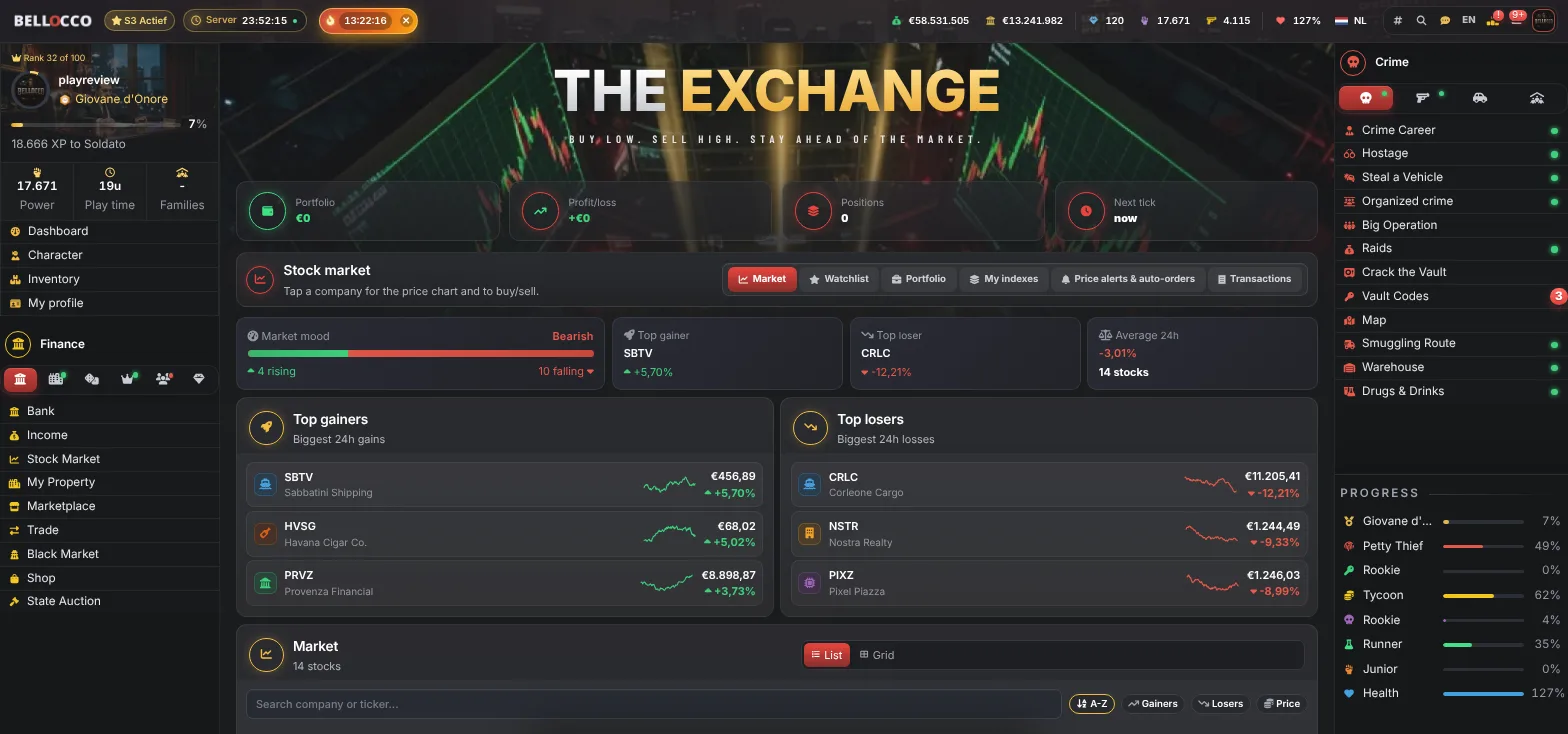
The stock market is a layer on top of the normal economy. Instead of leaving idle money in the bank, you buy shares of fictional companies and profit or lose with their prices. There is no minigame and no timing bar; you buy, hold, diversify and sell.
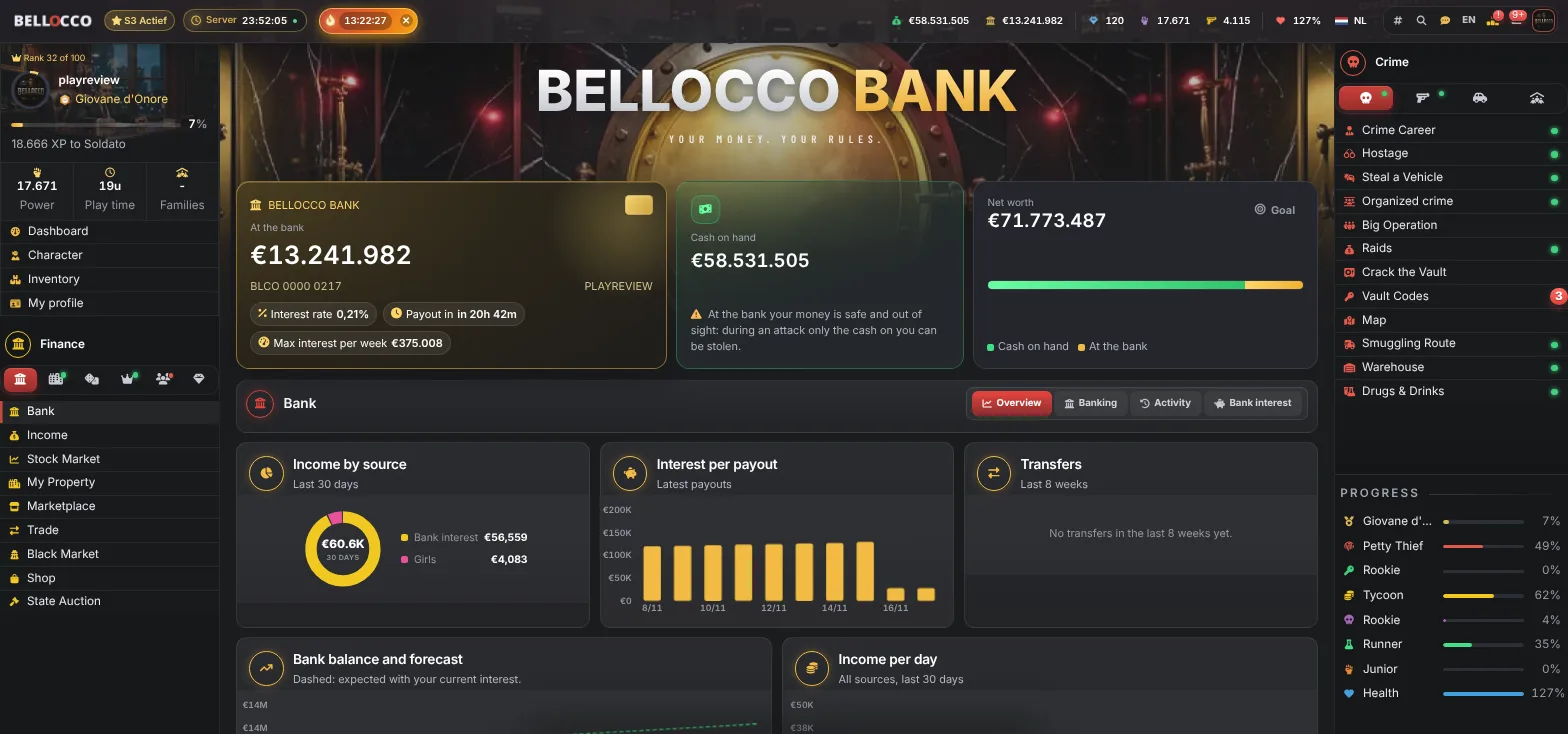
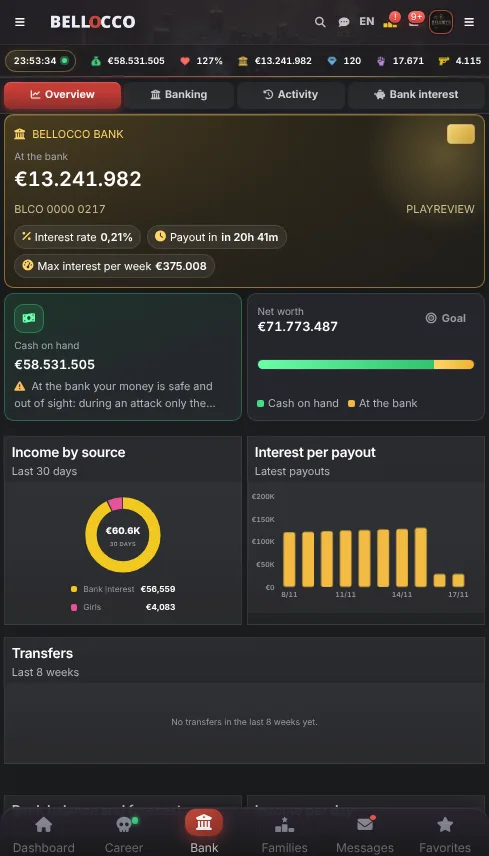
The market works with your bank balance, not the cash you carry. Purchases are deducted from your bank and sale proceeds go back to it, so move money to the bank first.
Fractional shares
You do not buy whole shares. You enter an amount in euros and receive a proportional number of fractional shares at the current price. Selling works the other way: you choose how many shares to sell or sell everything, and the proceeds are credited to your bank rounded down to whole euros.
A watchlist lets you follow a company without investing, so you can watch the price chart before buying.
Fourteen companies, eight sectors
The companies include Bellocco Concrete (BCTN) and Nostra Realty (NSTR) in construction and real estate, Corleone Cargo (CRLC) and Sabbatini Shipping (SBTV) in transport and logistics, Casa Fortuna Casino (CFCN) and Ristorante Bellocco (RBHD) in hospitality, Falcone Security (FLCN) and Vendetta Arms (VNDT) in security and weapons, Omerta Media (OMRT) and Pixel Piazza (PIXZ) in media and tech.
The rest are Provenza Financial (PRVZ) in finance, Grappa and Sons (GRPZ) and Havana Cigar Co. (HVSG) in consumer and luxury goods, and Milano Moda (MLMD) in fashion and luxury. Each sector has its own feel and risk profile.
How prices move
Each company has a trend that lasts for a while, so a price can keep moving in one direction for several ticks, combined with small fluctuations. Now and then a news event causes a bigger jump. At fixed intervals the market ticks and a new price is calculated.
A price can change by at most 8% in one move and can never fall to zero. Player orders also push the price: buying lifts it for the next buyer and selling lowers it for the next seller, with a cap per order so no single player can crash or inflate it alone. A countdown shows the next tick.
The position cap
To stop all-in bets, you can hold at most a fixed share of your own net worth, 20% by default, in one company. Net worth here is your bank balance plus the value of what you already own in that company. The ratio is the same for everyone and scales with your wealth.
There is also a minimum amount, so a new player with a small bank balance can still invest a meaningful sum. The cap pushes you to spread across several of the fourteen companies.
A simple approach
Split money across at least three sectors, keep a cash reserve in the bank for opportunities such as a business auction, and check charts before adding. Use the watchlist to learn how each company behaves before committing.
Avoid selling in a panic on a single tick: the 8% cap means big moves often come as a series of steps, giving you time to decide.
Risks and limits
Prices can fall as well as rise and nothing is guaranteed. The market is fictional and exists inside the game, so it carries no real-world financial meaning, and this page is not financial advice for real investing.
The market is also not the fastest way to grow. Crimes and businesses pay faster early on, and the stock market suits money you do not need soon.
Where it fits in a plan
In the first weeks keep most money in action: crimes, drugs and training. Once you have a stable income and idle bank money, move part into stocks. Reinvest when a season gives you a lump sum.
Details such as the position cap and tick size are balance values read on 14 November 2026 and can be tuned.
A worked example
Say you have €100,000 in the bank and a net worth of €400,000 including other assets. With the default 20% position cap you could hold up to €80,000 in one company, but a more careful split is €20,000 each in four companies from four sectors, for instance construction, transport, media and finance, with the rest kept as a reserve.
If one company's trend turns down, only a quarter of your stake is exposed. If another trends up, you can sell part and move the proceeds to the bank, where they are safe from attacks and available for a business auction.
Reading a chart without overthinking it
Each company has a price chart and a countdown to the next tick. Look at three things: the direction of the last few ticks, the size of the biggest moves and whether a news event has just occurred. A trend that has lasted a while can continue, but it can also reverse, so avoid committing everything at the top of a run.
Remember that your own orders move the price. A very large purchase raises the price for the next buyer, which is you if you buy in parts. Splitting a large order into several smaller ones over time is often calmer.
Stocks versus other uses of money
Money in stocks is not money in a business, a drug lab plot or a Shop purchase. Compare the opportunity cost: a plot that produces a batch every two hours may beat a stock, while a stock may beat idle bank money. Idle bank money earns nothing.
Because market ticks are periodic, stocks suit players who check the game a few times a day. They also work well for a player who is away on holiday, as a long position needs no input.
Questions to ask before each purchase
Which sector is the company in, and how much of my bank is already there? Is the last move part of a trend or a news jump? Do I need this money soon for a business auction, a flight or a family donation? If any answer is unclear, wait for the next tick.
Stocks and the rest of your plan
Decide a share of your bank for stocks, for example a quarter, and leave the rest liquid. Revisit the split after each season. If a business auction appears that you want, sell stocks to fund it, which is the point of keeping them liquid.
Best browser mafia games: what to look for · Best mobile mafia games · BELLOCCO Gazette
Mafia game economy guideHow to make money in a mafia gameMafia game casino guideMafia game tips and strategyMafia game seasonsFree mafia gameBrowser mafia gameWiki: Stock marketWiki: The bankWiki: Economy and balanceWiki: Businesses
Questions fréquentes
How many companies are on the BELLOCCO stock market?
Fourteen fictional companies across eight sectors.
Do I need cash or bank money to invest?
Bank money. Purchases are taken from your bank and sale proceeds go back to it.
Can I buy part of a share?
Yes. You enter an amount and receive fractional shares at the current price.
How much can a price move?
At most 8% per tick, and it can never fall to zero.
Is there a limit per company?
By default you can hold at most 20% of your net worth in a single company.
Can I lose money?
Yes. Prices follow trends and news events, and there is no guarantee.
Is this real investing?
No. The companies and money are fictional and exist only inside the game.
Ready to rule the underworld?
Create your character in one minute and join over 1,000 players building their empire.