
Mafia game economy guide: where money comes from and where it goes
Every persistent crime game is an economy first and a fight second. This guide explains how money enters and leaves BELLOCCO, how the bank, businesses, the marketplace, the state auction and the stock market fit together, and which choices keep your own balance growing.
Mis à jour
Screenshots
Start in 60 seconds
Create a free account and earn your first cash from crimes and jobs.
Put money in the bank vault, buy shares and open your first business.
Reinvest the income and watch the weekly interest and wealth tax.
Live from the game: businesses
| Business | Price | Income per hour |
|---|---|---|
| Hôpital | €500,000 | - |
| Usine de balles | €750,000 | - |
| Quartier rouge | €1,500,000 | - |
| Casino - Pierre-feuille-ciseaux | €4,000,000 | - |
| Casino - Jeu des nombres | €5,000,000 | - |
Faucets and sinks
A game economy has faucets that create money and sinks that remove it. BELLOCCO creates money mainly through crimes, drug sales, businesses, rewards from tasks, challenges, seasons and achievements. It removes money through travel tickets, hospital treatment, market commission, tax on casino profits, house edge, upgrade costs and family expenses.
The design goal is that a euro keeps roughly the same value for a new player and for a veteran. Without sinks, cash would pile up and prices would climb. When you read any number in this guide, remember that staff can switch the whole economy to another preset, so rewards and prices scale together even when absolute numbers change.
The earnings ladder
Crime income rises with rank. At rank 1 an attempt is worth about €113 on average, and with the 90-second cooldown a beginner earns in the order of €4,500 per hour if he plays the loop continuously. At rank 40 and above, a top player reaches several hundred thousand euros per hour. The curve is built so that higher payout means lower success chance.
Crime Career adds a second ladder next to the hostage jobs: five branches and twenty crimes with mastery levels, a heat meter that drops 4 points per minute, one hot job a day at 1.5 times the loot, and three daily orders. It is another source of cash and XP that scales with the same economy.
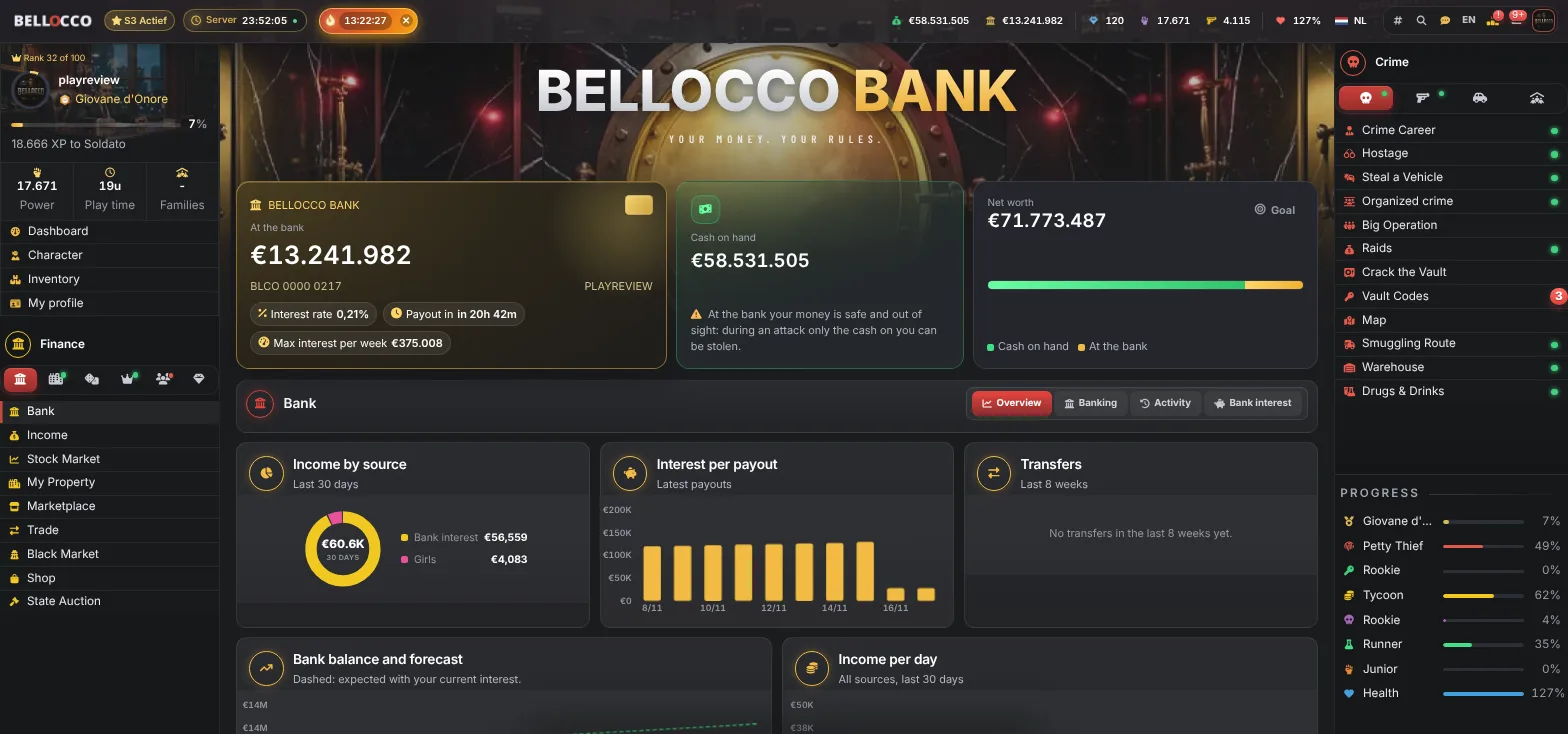
The bank is not just a safe
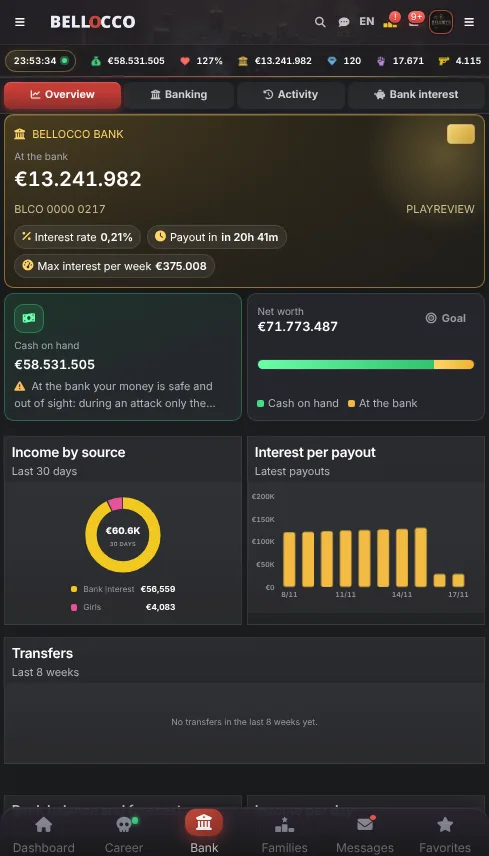
Banking is free and unlimited. It protects against theft in attacks and murders, and it is also the account that the stock market uses: investments are taken from your bank and sales return to your bank. If you want to invest, bank first.
Treat the pocket as a working float. Keep what the next few actions need and put everything else in the bank. This habit alone prevents the largest single loss most players suffer.
Businesses: passive income with a scarce supply
Every country has exactly one of each business type, and a player can own only one of each type across all countries. The base prices are a hospital at €500,000, a bullet factory at €750,000, a Red Light District at €1,500,000 and six casino tables from €4,000,000 (rock-paper-scissors) to €10,000,000 (roulette).
Owners set their own service prices within a band of 20% below or above the country base. You collect the vault through the properties page; casino owners withdraw profit above the starting bankroll after tax. Ownership is scarce on purpose: there are not enough of any type for everyone, so prices on the marketplace reflect demand.
Marketplace, trading and the state auction
The marketplace lists vehicles, parts, businesses, diamonds, bullets, drugs and vault codes, either at a fixed price or as an auction where your bid is reserved and refunded if you are outbid. A small fee is taken as a sink, and VIP halves it. Items on sale are locked so they cannot be sold twice.
Trading is direct: up to 12 items per side, both players set ready, both confirm, and the swap happens all at once or not at all. Cash and diamonds cannot be traded, to stop accounts moving value between each other. The state auction sells one ownerless business per day by default for 24 hours, with a reserve price, a minimum raise of 5% and a few extra minutes if a bid arrives at the end.
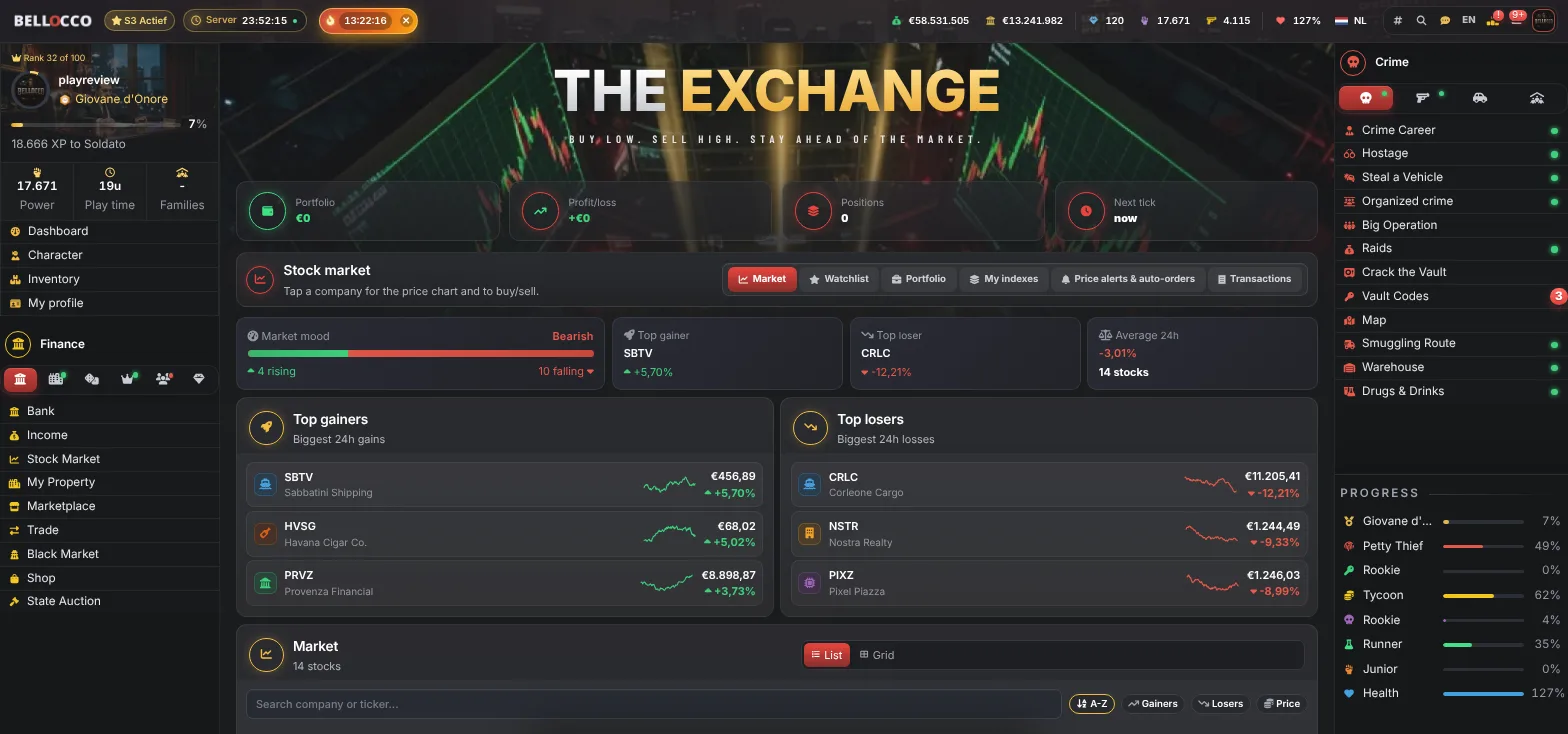
The stock market
The stock market has 14 fictional companies across sectors such as construction, logistics, hospitality, security, media, finance and luxury. You buy fractions of a share with money from your bank, sell part or all later, and can keep a watchlist. Each company has a trend that lasts for a while plus small fluctuations and occasional news events.
It is a place for idle bank money, not a guaranteed return. A diversified spread across several sectors lowers the effect of one bad trend, and holding some cash in the bank keeps you able to act when a business auction or a good market deal appears.
Price differences: the engine of the trade game
Prices differ by country for drugs, hospital treatment and bullets, and travel takes time and money. In the game data the base ticket price runs from €6,000 to €35,000 and the base flight time from three to fifteen minutes, depending on the destination, which means small loads rarely justify a trip but large loads do.
Drug midpoints differ widely: coke is worth about €35 per gram in Colombia and around €105 in Japan, weed about €6 to €13 and XTC about €28 to €52. Smuggling crates abroad uses the same differences with more risk and more reward. The more volume you move per trip, the more the ticket becomes a small cost.
Money habits that compound
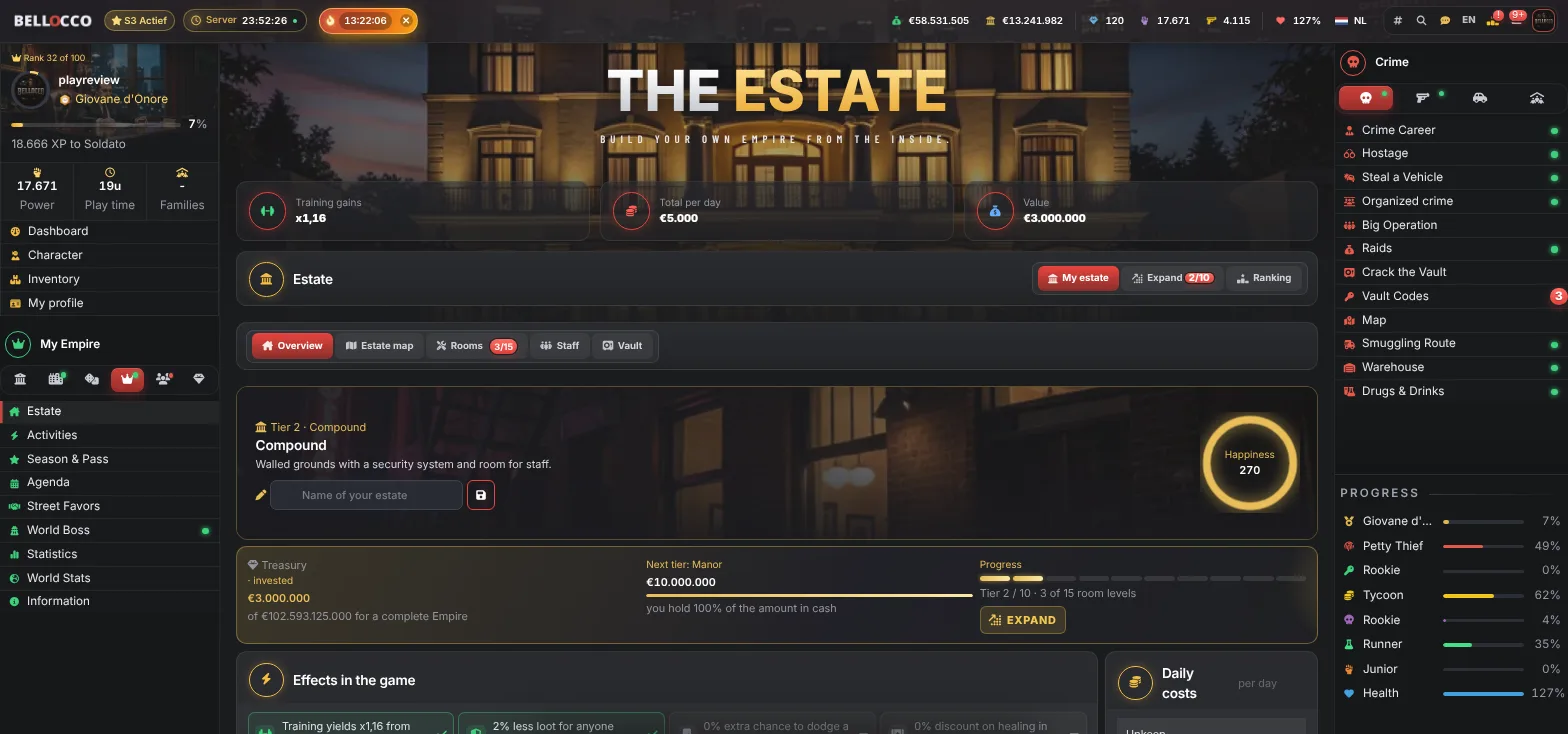
Invest in assets that produce while you are away: a business, a drug lab plot, a family business share. Reinvest early profit in things that raise your hourly income before you spend on cosmetics. Keep an eye on sinks you can avoid, such as paying for a flight with an almost empty load.
Finally, accept that paying can save time. VIP raises crime money by 10%, XP by 20% and shortens cooldowns, so a paying player moves faster. The economy is built so that a free player can still reach everything, but not as quickly, and this guide would be dishonest without saying so.
A starter budget
Early on, split your bank into three parts: a reserve for fees and flights, an investment bucket for production and a savings goal for a business or a family. Review it weekly. When the savings goal is within reach, check the marketplace and the state auction for a fair price before paying the full base price.
Best browser mafia games: what to look for · Best mobile mafia games · BELLOCCO Gazette
How to make money in a mafia gameDrug dealing game guideSmuggling game guideMafia game casino guideMafia game stock marketMafia game tips and strategyFree to play mafia gameMafia game seasonsWiki: Economy and balanceWiki: MarketplaceWiki: State auctionWiki: BusinessesWiki: Stock market
Questions fréquentes
How does money enter the BELLOCCO economy?
Money enters through crimes, drug sales, businesses and rewards from tasks, challenges, seasons and achievements. It leaves through travel, treatment, market fees, casino tax and the house edge.
Is my money safe in the bank?
Money in the bank cannot be stolen in an attack or a murder attempt, and moving it costs nothing. Only cash in your pocket is at risk.
Can I own several of the same business?
No. A player can own one business of each type across all countries, although there is no overall limit on how many different types you own.
How does the state auction work?
The state auctions one ownerless business, once a day by default, for 24 hours. Bids must beat the previous one by 5%, outbid money is refunded and late bids extend the auction.
Can I trade cash or diamonds with other players?
No. Direct trading covers items only, up to 12 per side, to stop accounts being used to move value.
Is the stock market safe?
No investment is guaranteed. Prices follow trends and news events, so you can lose money, and diversification across sectors reduces but does not remove that risk.
Does paying change the economy for me?
Yes, in speed. VIP and boosters save time, but every feature can be reached without paying.
Ready to rule the underworld?
Create your character in one minute and join over 1,000 players building their empire.